
Last Updated: November 4, 2026
Quick Summary
Sagging shelves can be fixed by adding support so the load is shared rather than carried by the board alone. Fit a central vertical support or T-brace to wide spans, add front and back stiffeners, re-anchor loose pins with a hardwood dowel, and upgrade to heavy duty metal supports rated well above the weight you store.
- A vertical support at the midpoint of a long span cuts the effective span in half.
- Standard plastic shelf pins are the weak point in most cabinets and crack or pull out.
- Drill out a damaged pin hole, glue in a hardwood dowel, then re-drill a fresh hole.
- Fit matching supports at all four corners rather than mixing heavy-duty and original pins.
- Put heavy items towards the ends and back, keeping the middle of a long span for lighter goods.
Table of Contents
- Why Kitchen Cabinet Shelves Sag and Bow
- Reinforcing Kitchen Cabinet Shelves: Your Repair Options Compared
- Heavy Duty Shelf Supports for Kitchen Cabinets
- Step-by-Step: Repairing a Sagging Shelf
- Repairing Melamine and Laminate Finishes
- Repair or Replace? Weighing Up the Cost of Custom Joinery Repairs
- Request a Free Quote for Shelf Repairs or New Cabinetry
- Frequently Asked Questions
Why Kitchen Cabinet Shelves Sag and Bow
Sagging shelves are one of the most common complaints we hear about kitchen cabinetry, and the cause is almost always structural rather than cosmetic. When a shelf bows under the weight of tinned goods, crockery or appliances, the board has passed its safe load limit for the distance it spans.
In older kitchens, the shelf itself rarely fails first; the way it is supported does.
The role of span distance and shelf thickness
Two measurements decide whether a shelf holds its shape: how far it stretches between supports, and how thick the board is. A longer span with a thin board will bow under far less weight than a short span with a thick one.
Thicker boards resist bending better because there is more material to share the load.
How particle board and MDF fail under load
Particle board and MDF are common in production cabinetry because they are cheap and finish well. But both have low tensile strength compared with plywood or solid timber.
Under steady weight, the board starts to bend. Once it bends, the internal fibres compress and never fully spring back. That is material fatigue, and it is why a shelf that sags today will only sag further tomorrow. Flat-pack boards are especially prone to this, for reasons covered in our guide to why flat-pack kitchen cabinets fall short.
Reinforcing Kitchen Cabinet Shelves: Your Repair Options Compared
Reinforcing kitchen cabinet shelves means adding support so the load is shared rather than carried by the board alone. There are four practical approaches, and the right one depends on how badly the shelf has bowed and how much weight it holds.
| Method | Best for | Effort | Result |
|---|---|---|---|
| Central vertical support or T-brace | Wide spans, heavy loads | Moderate | Stops future sag |
| Front and back stiffeners | Mild bowing, long shelves | Low to moderate | Adds rigidity |
| Metal shelf brackets or cleats | Loose or failed pins | Low | Re-anchors the shelf |
| Replacing the board | Severe, permanent bow | Moderate | Full reset |
Adding a central vertical support or T-brace
A vertical support fitted at the midpoint of a long span cuts the effective span in half. That single change does more for structural integrity than any other repair.
A T-brace works on the same principle. It is a timber or metal section fixed under the shelf along its length, forming a T shape with the board. The upright of the T resists downward bending.
Fitting front and back stiffeners
Stiffeners are strips of timber or metal screwed to the front or rear edge of the shelf. They add a rigid spine that resists deflection across the whole span.
A support strip at the back edge is the easiest win, because it is hidden from view. A front stiffener is more visible but adds more strength.
Heavy Duty Shelf Supports for Kitchen Cabinets
Heavy duty shelf supports for kitchen cabinets are rated metal brackets, pins or cleats designed to carry loads that standard plastic shelf clips cannot.
Standard plastic shelf pins are the weak point in most cabinets. They crack, pull out of the hole, or let the shelf drop a few millimetres at one corner. Metal pins, locking shelf clips and steel L-brackets cost little more and last far longer.
Matching the support to the failure
There are three common hardware upgrades, and each suits a different failure:
- Steel shelf pins with a locking collar replace plastic pins in the same 5mm holes and resist pull-out far better. They suit cabinets where the pins have elongated but the board is sound.
- Metal shelf support brackets or cleats screw to the cabinet side and carry the shelf on a flat arm rather than a pin. They suit shelves that have dropped at one end or where the pin holes are beyond repair.
- Full-depth shelf standards are slotted metal tracks screwed to the cabinet sides, with adjustable clips that spread the load along the track rather than through a single hole. They suit wide shelves and heavy loads, and they let you reposition shelves later.
When you buy hardware, check the rated weight capacity, not just the size. A bracket rated for heavy loads will hold a full shelf of crockery; a decorative one will not. As a guide, a shelf carrying everyday kitchen goods should be supported by hardware rated well above the weight you expect to store, because the rating assumes an even load and kitchen loads are rarely even.
Why the pin hole, not the pin, usually fails
The pin itself is rarely the first thing to break. The hole in the cabinet side enlarges under load, the pin sits loose, and the shelf drops at that corner. Upgrading to a metal pin in a worn hole does not solve the problem, which is why re-anchoring the hole with a hardwood dowel comes before any hardware swap. Fit the better hardware into a sound hole, not a damaged one.
A note on mixing hardware
It is tempting to fit heavy-duty supports at the front and leave the original pins at the back. This concentrates the load on the new fittings and often pulls them out. Fit matching supports at all four corners, or at least at both ends of the same edge, so the shelf shares its load evenly.
Step-by-Step: Repairing a Sagging Shelf
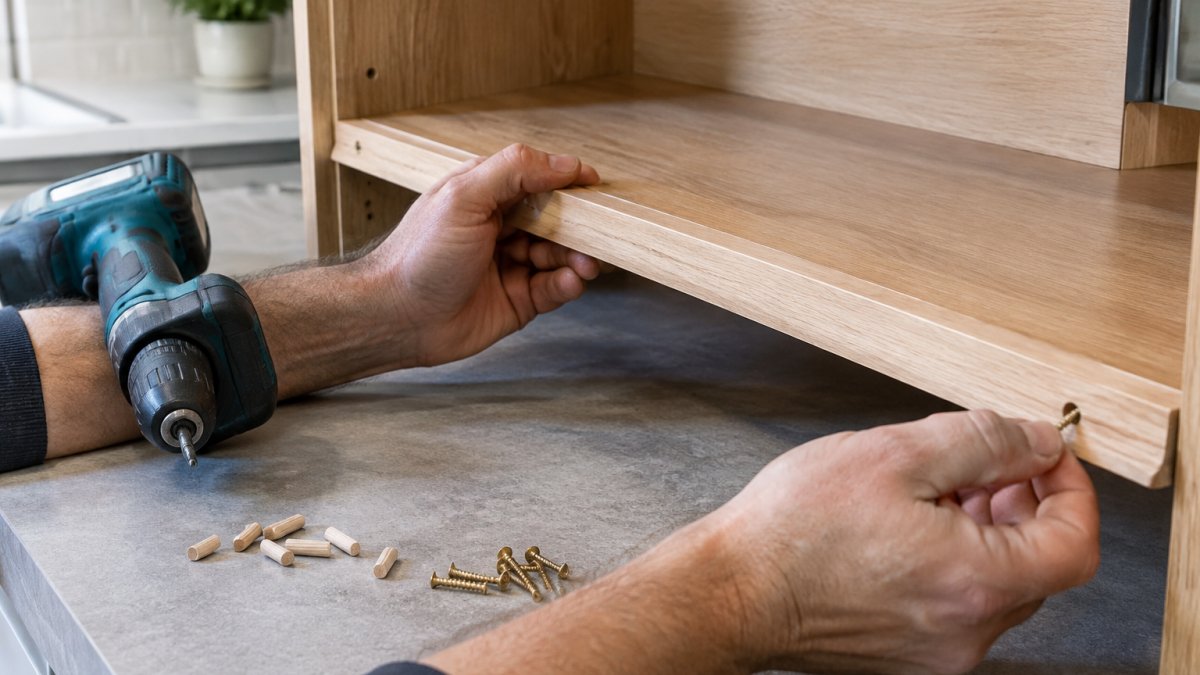
Repairing a sagging shelf can often be done with a drill, wood screws, a drill bit, a tape measure and a spirit level. Work on one shelf at a time and clear it fully first.
Step 1: Clear the shelf and check the pins
Empty the shelf completely and inspect the shelf pins and clips at each corner. Look for cracked plastic, pins sitting loose in their holes, or a shelf that has dropped at one end.
Check the cabinet sides as well as the shelf. If the pin holes themselves are elongated or the board around them has softened, the failure is in the carcass, not the shelf, and no amount of bracing will fix a support that is pulling out of the cabinet wall.
Step 2: Re-anchor loose pins and fit brackets or cleats
For a loose pin, drill out the damaged hole to the diameter of a hardwood dowel, glue the dowel in flush, and re-drill a fresh hole for the pin once the glue has set. Fit metal L-brackets or timber cleats under the shelf at each end and along the back for extra support.
Watch out: drilling into melamine-faced or laminated board without backing the exit hole will blow out the finish on the underside, so clamp a scrap block behind the board and use a sharp brad-point bit at low speed.
Step 3: Redistribute the weight load
Load distribution matters as much as hardware. Put heavy items like tins and appliances towards the ends and the back, where the shelf is strongest.
A simple rule of thumb: if a shelf is already braced at the midpoint, treat each half as its own span and load it accordingly. Never concentrate the heaviest items directly over a single support point, because that point takes the full load rather than sharing it.
Step 4: Check the repair under load
Refit the shelf, load it gradually and watch the front edge against a straight edge or the spirit level. A repair that still deflects under normal kitchen weight needs a mid-span support, not more screws. Leave the shelf loaded for a day before you consider the job done, because some movement only shows once the board has had time to settle.
Repairing Melamine and Laminate Finishes
Melamine and laminated board repairs need care, because a chipped or cracked surface cannot be sanded back like solid timber. The finish is a thin layer over the core, and once it lifts, moisture gets in.
For small chips, fill with a colour-matched melamine filler and smooth it level. For a cracked or lifting edge, run a thin bead of wood glue under the laminate, clamp it flat and wipe away the excess before it sets.
Repair or Replace? Weighing Up the Cost of Custom Joinery Repairs
The cost of custom joinery repairs depends on how many shelves are affected, the hardware needed and whether the cabinet carcass itself is sound. A simple re-pin and bracket job is a small outlay; replacing bowed boards or rebuilding a carcass costs more.
Repair makes sense when the cabinet carcass is solid and only one or two shelves have bowed. If you are unsure which side of the line your cabinets sit on, our guide to the signs your kitchen cabinets need replacing walks through the faults that mean it is time to swap. It also helps to understand why custom cabinetry costs more before you commit to a rebuild.
Request a Free Quote for Shelf Repairs or New Cabinetry
Sagging shelves can be fixed, and most are worth fixing before you consider a full replacement. The question is whether a repair will hold, and that comes down to the carcass, the hardware and the load.
If you would rather hand it to a joiner, East Coast Joinery Solutions provides professional installation for custom and supplied cabinetry.
Get started with East Coast Joinery Solutions and request a free quote for your shelf repair or new cabinetry.
Frequently Asked Questions
What is the best way to reinforce a sagging shelf?
For most kitchen cabinets, a front stiffener screwed to the shelf edge plus a central vertical support solves the problem. A 19mm plywood or solid timber strip fixed with wood screws and pilot holes resists deflection far better than the original particle board alone. Heavy duty shelf supports or cleats may be enough for shorter spans. Wider shelves benefit from a T-brace or mid-span support so the load transfers to the cabinet carcass rather than the shelf itself.
Can you fix a sagging particle board shelf?
Yes, but the repair depends on how far it has bowed. Particle board loses tensile strength once the fibres break, so a shelf that has sagged for months may stay curved even after support is added. Flip the shelf over so the bow faces upward, then add a stiffener and central support to stop it dropping again. If the board is cracked or crumbling around the shelf pins, replacing it with plywood or MDF of the same thickness is the more durable fix.
How do I stop my kitchen shelves from bowing?
Keep heavy items such as tinned goods, cast iron and bulk flour close to the cabinet sides and the shelf's front edge, where support is strongest. Reduce the span by adding a vertical divider or mid support if the shelf runs wide. Fit heavy duty shelf supports rated for the load, and check shelf pins are seated fully in their holes. A 16mm shelf carrying jars across a 1m span will always deflect; a 19mm shelf with a stiffener will not.
Is it better to repair or replace sagging cabinet shelves?
Repair first if the cabinet carcass and shelf pins are sound and the board is only mildly bowed. A stiffener, brackets and a load reshuffle cost little and add years of service. Replace when the board has cracked, the pin holes have torn out, or the finish is water-damaged. The cost of custom joinery repairs for a full shelf replacement is usually lower than new cabinetry.
